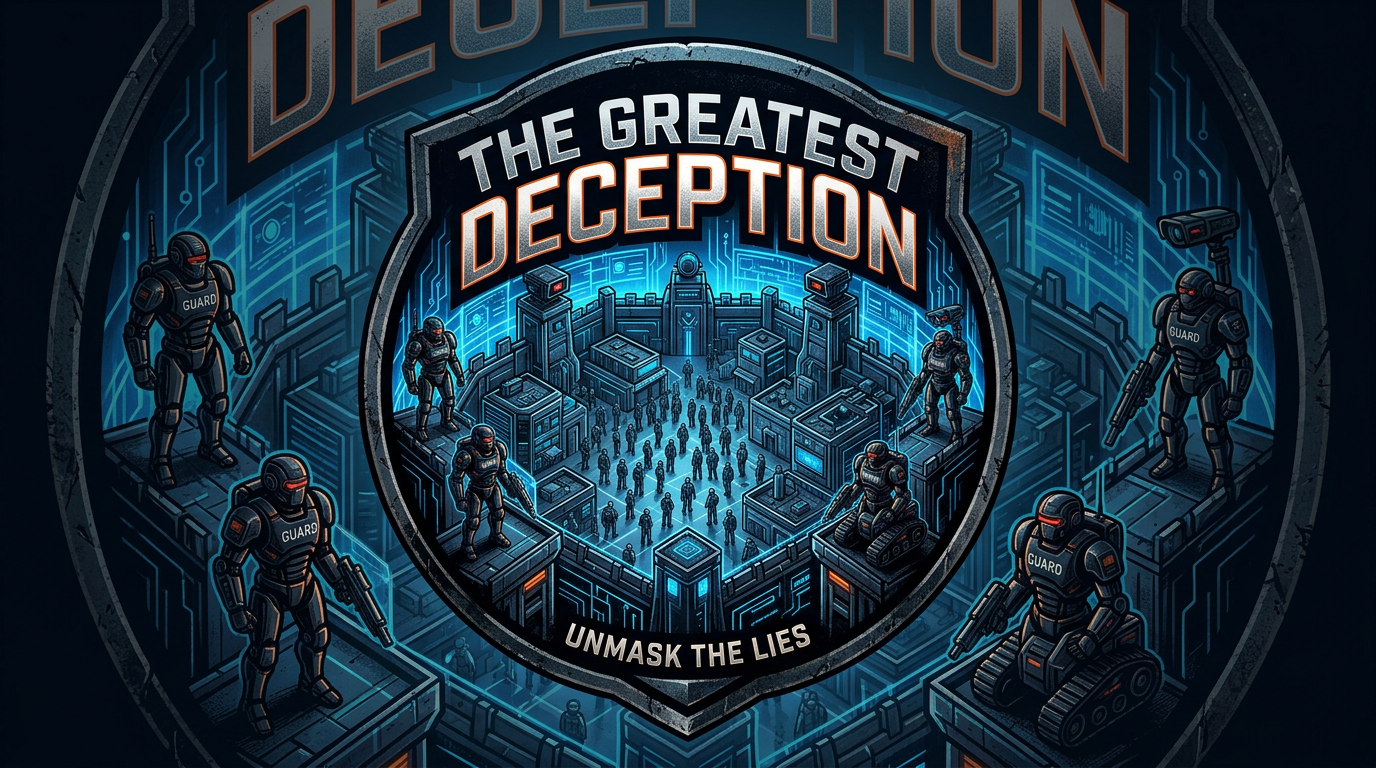
The Greatest Deception
Prologue: The Land of Open Doors
In the nation of Aurelia, every child learned the same pledge before they learned multiplication.
Hand over heart. Eyes forward. Chin high.
“We are free because we choose. We choose because we are free.”
The words were painted above schoolhouse doors, engraved on courthouse walls, carved into the marble of the Grand Assembly, and displayed in shimmering blue letters every morning across the lenses of the people’s home screens.
Aurelia was the envy of the known world.
Its cities gleamed like constellations fallen to earth. Towers of glass and silver rose into clouds seeded by government drones to appear bright on national holidays. Maglev trains whispered from coast to coast. Every home had heat, light, entertainment, and access to the CivicNet, the greatest communication system ever built.
The people voted every four years.
They argued loudly and passionately.
They wore badges, flew flags, chanted slogans, mocked their opponents, celebrated victories, mourned defeats, and believed with bone-deep certainty that their voices shaped the destiny of their nation.
There were two great political banners.
The Forward Coalition, dressed in blue and white, promised compassion, progress, fairness, and reform.
The Heritage Union, dressed in red and gold, promised strength, tradition, order, and prosperity.
Occasionally, a third faction rose from the fringes, bright as a spark in dry grass. The people called these third movements brave, foolish, dangerous, necessary, inspiring, or doomed—depending on which channel they watched.
And they were always doomed.
No matter the speeches, no matter the scandals, no matter the changing faces on the posters, power passed back and forth between the two great parties like a coin flipped between the same pair of hands.
Above it all, unseen and unspoken, there was another power.
It had no party color.
No campaign song.
No public office.
No face on the screen.
The people of Aurelia had many names for imaginary enemies. They blamed rival nations, corrupt politicians, greedy companies, reckless scientists, extremists, criminals, foreign spies, bad luck, old gods, new technology, and one another.
But almost no one knew the true name of the hand around their civilization’s throat.
It was called The Loom.
And for nearly three hundred years, it wove the lives of millions without leaving fingerprints.
Chapter One: The Comfort of Chains
Mara Vey lived on the eighty-sixth floor of a residential tower in Caldris, the capital city of Aurelia.
Every morning, her walls woke before she did.
Soft amber light bloomed across the ceiling. The scent of roasted kaf and citrus bread filled the apartment vents. Her CivicLens, a slim transparent tablet mounted beside her bed, chimed twice.
“Good morning, Mara,” said the familiar voice of EVA, her household assistant. “It is seven-oh-two. Your rest quality was eighty-seven percent. Your civic mood index is stable. The weather today is mild sun with patriotic cloud cover beginning at noon. You have three unread notices, one hydration recommendation, and a reminder to vote in the district primary.”
Mara groaned and pulled the blanket over her face.
“Dismiss hydration recommendation.”
“Dismissed,” EVA said pleasantly. “Would you like a brief summary of today’s national developments?”
“No.”
“Understood. Here is your brief summary.”
Mara threw a pillow at the wall screen, missing it by several feet.
The screen turned on anyway.
A smiling anchor appeared with flawless hair and eyes too bright to be trusted.
“Good morning, Aurelia. With primary season underway, citizens across our great nation are preparing to make their voices heard. Senator Cal Voss of the Heritage Union continues to surge in heartland districts, while Governor Elian Mere of the Forward Coalition has gained momentum among younger voters following last night’s Unity Forum.”
Images flashed: crowds cheering, flags waving, candidates shaking hands with workers in factories so clean they looked unused.
Then came a familiar segment: The Third Choice?
A woman with silver braids appeared at a small podium, speaking to a crowd gathered in the rain.
“Independent candidate Serah Vale continues her unusual campaign calling for transparency regarding CivicNet oversight, weather-management contracts, and central banking algorithms.”
The anchor’s smile tightened by half a millimeter.
“Critics from both major parties warn that Vale’s rhetoric may encourage distrust in institutions at a time when unity is essential.”
Mara sat up.
Serah Vale’s image remained on the screen for only seven seconds before the broadcast moved on to sports.
Seven seconds was enough.
Mara worked in the Ministry of Civic Harmony, where she designed behavioral-response models for public communication campaigns. Her job was to help the government understand how people reacted to information.
Or, as her brother Jalen called it, “teaching the cage how to sing.”
Jalen had always been dramatic.
He had also vanished six months ago.
Officially, he was classified as voluntarily relocated. People did that sometimes. They unplugged, moved to rural quiet zones, joined spiritual communes, chased storms, disappeared into mountains.
Unofficially, Mara knew her brother would never have left without saying goodbye.
Not unless he had discovered something.
Not unless he had been taken.
A small icon pulsed in the corner of the wall screen.
CIVIC PARTICIPATION REMINDER: YOUR THOUGHTFUL ENGAGEMENT MATTERS.
Mara stared at it.
“EVA,” she said quietly, “who funds Serah Vale?”
“Independent candidate Serah Vale receives financial support from small donors, civic reform groups, and several unverified organizations currently under audit.”
“Play her full speech from last night.”
There was a pause.
“I’m sorry, Mara. That content is temporarily unavailable pending accuracy review.”
Mara felt a cold bead of unease slide down her spine.
“Find transcripts.”
“Transcripts are temporarily unavailable pending accuracy review.”
“Find commentary.”
The screen filled with headlines.
VALE’S DANGEROUS CLAIMS COULD UNDERMINE DEMOCRACY
EXPERTS WARN AGAINST CONSPIRACY RHETORIC
WHY THIRD-PARTY MOVEMENTS HELP EXTREMISTS
UNITY MATTERS MORE THAN EVER
Mara laughed once, without humor.
She had written headlines like those.
Not those exact ones, perhaps. But close enough.
Her apartment door chimed.
She frowned. “Who is it?”
No answer.
The chime sounded again.
When Mara opened the door, there was no one in the hallway.
Only a small paper envelope on the floor.
Paper was rare. In government districts, almost suspicious.
She picked it up.
Inside was a black memory shard and a note written by hand.
Three words.
Jalen was right.
Chapter Two: The Candidate Who Could Not Win
The Grand Assembly sat at the heart of Caldris, a sprawling white building with one hundred pillars, each representing a foundational liberty. Schoolchildren toured it daily. Guides told them the pillars were made from stone quarried by the first free settlers.
Mara had once believed that.
Now she knew the stone was synthetic composite poured forty years ago after the original pillars cracked from underground excavation work the public had never been told about.
In Aurelia, truth was not destroyed.
It was renovated.
Mara arrived at the Ministry just before nine. The lobby scanners washed over her with blue light. Her identity, temperature, stress levels, hormone fluctuations, and probable emotional state appeared briefly on the security officer’s lens.
“Morning, Analyst Vey,” he said.
“Morning.”
“Rough sleep?”
She stopped.
He shrugged. “System flagged mild agitation.”
Mara forced a smile. “Election season.”
He laughed. “Tell me about it.”
Her office was a glass-walled pod overlooking the Civic Forum, where government staff moved through curved corridors like blood cells in a body.
On her desk waited her assignment for the day.
PROJECT: VALE CONTAINMENT
Objective: Minimize public confidence in unauthorized electoral narratives while maintaining perception of open democratic fairness.
Mara read the line twice.
A month ago, she would not have flinched.
She would have built models predicting which words made Serah Vale sound unstable, which clips made her supporters appear angry, which questions caused undecided citizens to retreat toward “safe” major-party choices.
She would have told herself that democracy needed guardrails.
That lies spread faster than truth.
That experts knew best.
That public trust was fragile.
That protecting citizens from harmful confusion was not censorship—it was care.
Now, the black memory shard in her pocket seemed to burn against her thigh.
She plugged it into her private terminal only after disabling three layers of workplace monitoring—something Jalen had taught her when they were teenagers hacking school menus to give themselves extra dessert credits.
A single file opened.
It was a video.
Jalen appeared onscreen, thinner than she remembered, eyes shadowed, face lit by a trembling yellow lamp.
“Mara,” he said, “if you’re watching this, I’m either dead, captured, or somewhere even the CivicNet can’t reach.”
Her hand flew to her mouth.
“I don’t have much time. Everything we joked about, everything I suspected—it’s worse. Aurelia isn’t being governed. It’s being managed. The parties are instruments. The elections are pressure valves. The economy is a leash. The weather grid is a weapon. CivicNet doesn’t just monitor searches and messages. It builds predictive maps of thought. It knows what people may believe before they believe it.”
Mara’s pulse hammered.
Jalen leaned closer.
“There is no real opposition at the top. Forward and Heritage answer to the same hidden authority. They call themselves The Loom. Their central node is under Caldris, beneath the Grand Assembly. But listen carefully—Aurelia is not the whole world, Mara. It isn’t even the whole story. There are settlements beyond the mapped borders. Survivors. Other civilizations. And not only on this planet.”
The video glitched.
For one second, another image appeared: a sky with two moons.
Then Jalen returned.
“They have lied about life beyond our atmosphere for generations. Contact happened long ago. The public wasn’t told because a population that knows it is not alone becomes harder to control. It starts asking bigger questions.”
A loud bang sounded somewhere offscreen.
Jalen looked away.
“Mara, if a woman named Serah Vale reaches the final debate, watch the sky over the western sea. The Loom will not risk exposure. They’ll stage a crisis. Maybe a war scare. Maybe a storm. Maybe worse. I found references to an end-times protocol called Black Harvest.”
He swallowed.
“Find Orin Pell. Trust no official channel. Trust no sudden hero. And if Caldris begins to shake, get east. Beyond the Ashen Ridge. The old maps are false. There is land there. People. A place called Levitica.”
The door behind him burst open.
The video ended.
Mara sat frozen.
A message appeared on her terminal.
Unauthorized external media detected. Security review initiated. Please remain calm.
Across the office, a camera turned toward her.
Mara did not remain calm.
She ran.
Chapter Three: Orin Pell
Mara knew Orin Pell only as a ghost in Ministry databases.
Former climate engineer. Former systems architect. Former advisor to the Office of Strategic Continuity. Publicly disgraced after a nervous breakdown. Privately erased from most records.
His last listed address was in the lower industrial quarter beneath Caldris, where the city’s beautiful towers sank into older neighborhoods of rust, steam, and forgotten people.
By the time Mara reached the lower levels, her access credentials had stopped working.
Her CivicLens displayed a calm message:
TEMPORARY IDENTITY VERIFICATION HOLD. PLEASE REPORT TO NEAREST CIVIC ASSISTANCE CENTER.
She crushed it beneath her heel in an alley slick with rain that had not been forecast.
Without the lens, the world felt naked.
No floating directions. No mood prompts. No targeted music. No alerts telling her which streets were safest, which cafés aligned with her health goals, which strangers had compatible trust scores.
For the first time in years, silence belonged to her.
She found Orin Pell in a machine chapel.
That was what the locals called the abandoned power station where old engineers gathered to repair forbidden devices: radios, analog watches, combustion engines, printed books with broken spines.
Orin was older than she expected, with bronze skin, white hair tied behind his head, and one mechanical hand that clicked softly when he moved.
“You look like your brother,” he said before she gave her name.
Mara took a step back.
“You knew Jalen?”
“I tried to keep him alive.”
“You failed.”
Orin accepted that without defense. “Yes.”
Mara hated him for not arguing.
She followed him into the chapel’s basement, where seven people sat around a wooden table lit by candles and battery lamps. They looked nothing like revolutionaries.
There was an old schoolteacher named Nima Cross.
A former banking programmer named Tavio Renn.
A weather-grid technician named Sella Myr.
A quiet medic named Ilan Vos.
Two siblings, Kesh and Ryn, who smuggled people through maintenance tunnels.
And a young girl no older than sixteen named Lio, who stared at Mara as if deciding whether she was worth saving.
Orin placed a metal box on the table.
“This,” he said, “is the part of Aurelia that does not exist.”
Inside the box were maps.
Real maps.
Not the polished schoolroom version showing Aurelia bordered by endless toxic wastelands and dead oceans.
These maps showed mountain passes, river systems, settlements, migration routes, and entire regions labeled with names Mara had never heard.
The Verdant Expanse.
The Glass Desert.
The Free Coast.
Levitica.
Mara touched the last name.
“My brother mentioned this.”
“He reached them,” Orin said. “Briefly. The Leviticans are descendants of those who escaped early Loom experiments centuries ago. They built beyond the Ashen Ridge, outside the range of CivicNet towers.”
Nima Cross leaned forward. “And they are not alone. There are others. Some human. Some not.”
Mara laughed because the alternative was screaming.
“Other planets?”
Orin nodded.
“Aurelia has known for two hundred years. The first confirmed contact came from a world called Veyr, orbiting a red star visible in winter. Their envoys offered knowledge, medicine, and partnership. The founders of The Loom saw only threat. If people learned abundance was possible without centralized control, the entire structure would collapse.”
Tavio Renn slid a thin stack of documents across the table.
“Banking records. The central bank is not simply regulating money. It is regulating behavior. Interest rates, credit scores, insurance access, housing permits, education approvals—all adjusted by predictive obedience models.”
Sella Myr added, “The weather grid was built to reduce droughts and hurricanes. Now it punishes regions, protects allies, ruins harvests, moves populations, and hides operations under ‘natural disaster’ classifications.”
Mara looked from face to face.
“And wars?”
No one spoke.
Orin finally said, “Not all. But enough.”
Mara sat down heavily.
The world she had lived in did not shatter all at once. It folded inward, like a stage set collapsing after the audience had gone home.
“How many people know?” she whispered.
“More every day,” said Nima. “Not enough.”
“And Serah Vale?”
Orin’s expression darkened.
“She was allowed to rise.”
“Allowed?”
“Third candidates always are. They absorb anger. They make people feel alternatives exist. Then they are humiliated, absorbed, or blamed for chaos.”
“But this time?”
“This time she got too close to proof.”
Sella activated a projector. A grainy model of Aurelia appeared, then zoomed toward the western sea.
“Three days from now, Serah Vale will speak at the final debate in Caldris. Her team has hidden evidence inside her closing statement, set to release across multiple channels at once.”
Mara’s heart lifted.
“Then we can expose them.”
Orin shook his head.
“The Loom knows. They are preparing Black Harvest.”
The projection changed.
Storm patterns formed over the western sea, impossibly vast. Seismic fault lines beneath Caldris glowed red. Power-grid nodes pulsed like infected wounds.
“It will look like a chain of natural disasters,” Sella said. “A superstorm. A grid collapse. A quake triggered by deep-resonance drilling. Flooding. Fires. Panic.”
Ilan the medic spoke softly. “Millions could die.”
“Why?” Mara asked.
Orin’s mechanical hand clicked once.
“To destroy evidence, eliminate unstable populations, justify emergency rule, and reset the national mind. Fear makes people obedient.”
Mara thought of the pledge.
We are free because we choose.
She wanted to weep.
Instead she said, “How do we stop it?”
Orin looked at her with terrible gentleness.
“We probably can’t.”
The room fell silent.
“Then what can we do?”
Kesh, the smuggler, answered.
“We get as many people out as we can.”
Chapter Four: The Loom Beneath the Marble
The evacuation began with whispers.
Not panic. Panic would trigger the CivicNet.
Instead, they used old things.
Paper notes inside loaves of bread.
Chalk marks under bridges.
Children’s songs with altered verses.
Analog radio bursts hidden beneath static.
Religious gatherings.
Funerals.
Wedding caravans.
Underground theater performances where lines from ancient plays became directions.
“Bring warm clothes.”
“Travel east.”
“Do not carry lenses.”
“Leave before the third bell.”
“Trust the lantern with green glass.”
Mara became what she had once been trained to defeat: a distributor of unauthorized reality.
She knew the Ministry’s systems, knew how suspicion moved, knew which words caused surveillance spikes and which phrases looked harmless. She planted false emotional patterns. She made escape chatter appear like consumer anxiety, romantic gossip, sports frustration, and recipe sharing.
A sentence about soup meant tunnel access.
A complaint about laundry meant drones nearby.
A heart emoji after midnight meant someone had been arrested.
The resistance called itself nothing at first. Names were dangerous.
But Lio, the sixteen-year-old, began referring to them as the Fever Ants, because “we are small, everywhere, and making the giant sick.”
Nima misheard it as Fevorant and laughed until she cried.
The name stuck in secret.
Fevorant.
Burning with devotion.
Fervent, but stranger. Their own.
On the second night, Mara and Orin broke into a forgotten maintenance shaft beneath the Grand Assembly.
The shaft descended farther than any public blueprint admitted.
Down past ceremonial storage.
Past geothermal pipes.
Past sealed doors marked with symbols Mara did not recognize.
Finally, they reached a viewing chamber overlooking the heart of Aurelia.
It was not a room.
It was a cavern.
Beneath the marble pillars of the Grand Assembly stretched a machine city glowing with cold light. Towers of servers rose like black trees. Rivers of coolant shone blue. Thousands of cables descended from the ceiling like roots feeding on the nation above.
At the center hung a sphere of mirrored panels, rotating slowly.
The Loom.
Mara’s breath caught.
“How many people work here?”
“Very few,” Orin said. “Most who serve it never see it. Ministers. Party leaders. Bank governors. Intelligence directors. Media architects. Corporate stewards. They each hold threads. None are told they hold a noose.”
On a platform below, a group of officials stood before the mirrored sphere.
Mara recognized some instantly.
The Heritage candidate, Cal Voss.
The Forward candidate, Elian Mere.
The director of CivicNet.
The chairwoman of the Central Bank.
The Minister of Weather Stability.
And an old man in a plain gray suit whom Mara had never seen on any broadcast.
Everyone else stood slightly behind him.
“The puppet master?” Mara whispered.
“One of them,” said Orin. “His name is Aster Rhone. Publicly, he does not exist.”
Below, Aster Rhone spoke with calm authority.
“Serah Vale’s final release cannot be permitted. Black Harvest begins at debate hour. We will preserve essential infrastructure and loyal population centers. Losses will be mourned. Unity measures will pass unanimously.”
Cal Voss shifted uneasily. “The casualties projected—”
“Will be attributed to unprecedented natural convergence,” Rhone said.
Elian Mere’s voice trembled. “There are children in the flood zones.”
Rhone turned.
“There are always children in the flood zones.”
No one spoke after that.
Mara’s nails dug into her palms.
Orin touched her shoulder. “We need to go.”
But Mara was staring at the mirrored sphere.
“What if we broadcast this?”
“The Loom’s internal network is sealed.”
“What if it wasn’t?”
“Mara—”
“My brother died for proof. Serah Vale may die for proof. Millions may die without it. If people are going to run, they need to know why.”
Orin’s jaw tightened. “A broadcast from here would last seconds.”
“Seconds can change history.”
For the first time since she had met him, Orin smiled.
“You really are Jalen’s sister.”
Chapter Five: Debate Night
The final debate was held in Unity Hall, beneath a ceiling painted with the mythic founding of Aurelia: farmers, inventors, soldiers, teachers, and lawmakers gathered beneath a sunrise.
Outside, rain began to fall over Caldris.
It was not scheduled.
Inside the hall, Serah Vale stood at the third podium.
She looked smaller than the major candidates, dressed not in party colors but in simple gray. Her silver braids rested over one shoulder. Her face was lined, tired, alive.
The moderators treated her with polite contempt.
“Candidate Vale,” one said, “you have repeatedly claimed that unelected forces influence national policy. Are you suggesting that voters are incapable of understanding their own democracy?”
Serah smiled faintly.
“No. I am suggesting they understand it so well that great effort has been spent convincing them not to trust themselves.”
The audience stirred.
Cal Voss attacked her as reckless.
Elian Mere accused her of endangering public trust.
Serah listened.
Then, during her closing statement, she looked directly into the main camera.
“My fellow citizens,” she said, “you have been told your whole lives that freedom means choosing between doors built by others. But a cage with two exits painted on the wall is still a cage.”
The broadcast flickered.
At that exact moment, beneath the Grand Assembly, Mara drove Jalen’s black memory shard into an access port at the base of The Loom.
Alarms screamed.
Orin’s mechanical hand sparked as he forced open a security panel.
“Thirty seconds!” he shouted.
“Give me sixty!”
“I can give you fire and a prayer!”
The sphere above them rotated faster. Mirrors flashed. A voice filled the cavern, smooth and genderless.
Unauthorized intrusion. Civic stability threat detected.
Mara’s stolen console filled with code.
For an instant, The Loom entered her mind—not literally, though it felt that way. It showed her herself as data.
Mara Vey.
Age thirty-two.
Stress intolerances.
Childhood fears.
Romantic regrets.
Purchasing impulses.
Political drift risk.
Grief response to missing sibling.
Likelihood of rebellion after exposure: 72%.
Recommended intervention: removal.
She almost froze.
Then she laughed.
“You don’t know me,” she whispered.
She opened every channel she could touch.
The debate broadcast split.
Across Aurelia, wall screens, CivicLenses, public billboards, school displays, train windows, restaurant menus, and courtroom monitors went black.
Then Jalen appeared.
Then documents.
Then maps.
Then recordings from beneath the Grand Assembly.
Aster Rhone’s voice echoed across the nation:
“There are always children in the flood zones.”
For twelve seconds, all of Aurelia saw the hand behind the curtain.
Twelve seconds was enough.
Then the screens went dark again.
And the sky over Caldris tore open.
Chapter Six: Black Harvest
The storm arrived like a living thing.
Clouds coiled above the western sea, black and green, lit from within by silent lightning. Wind slammed into Caldris hard enough to shatter tower windows. The river rose six meters in twenty minutes. Sirens wailed, then cut out, then returned as garbled hymns.
The earthquake began at 9:14 p.m.
It rolled beneath the city like a beast turning in sleep.
Roads split. Bridges buckled. The Grand Assembly’s synthetic pillars cracked one by one, each breaking with a sound like cannon fire.
The official emergency broadcast blamed unprecedented tectonic-hydrological convergence.
But millions had seen the truth.
Some obeyed the emergency instruction to shelter in place.
Many did not.
Because of the whispers, because of the chalk marks, because of the songs, because of the green lanterns, tens of thousands were already moving east before the worst came.
Mara emerged from the underground access tunnels with Orin and found the city transformed into nightmare.
Rain fell sideways.
Drones spun helplessly through the air.
A luxury tower burned from the middle floors upward, its flames bending blue in the chemical wind.
People filled the streets, some screaming, some praying, some carrying children, elders, pets, bags, portraits, bread, medicine, whatever they could hold.
At the old rail station, Kesh and Ryn had opened maintenance gates leading into freight tunnels beneath the city’s eastern edge.
“This way!” Ryn shouted, holding a green lantern high. “No lenses! No trackers! Keep moving!”
A man in a business suit grabbed Mara’s arm.
“What is happening? Who do we trust?”
Mara looked at his terrified face and realized no answer would ever be enough.
“Each other,” she said.
The evacuation became a river of bodies beneath the earth.
Nima led schoolchildren in songs to keep them calm.
Ilan treated wounds with shaking hands.
Tavio used stolen bank overrides to open sealed transit corridors.
Sella, from a weather substation miles away, fought the storm grid long enough to weaken the eastern winds.
Lio carried three children on a luggage cart and swore at anyone who slowed down.
Behind them, Caldris drowned.
At midnight, the western dam failed.
A wall of water tore through the lower city.
Mara felt the tunnel tremble. Dust fell from the ceiling. The lights went out.
For a moment, there was only darkness and the sound of thousands breathing.
Then, one by one, green lanterns flickered back to life.
Not many.
Enough.
They walked for eleven hours.
Some did not make it.
The old died in the arms of strangers.
The injured were carried until the carriers collapsed, then lifted by others.
Children asked where their parents were.
Parents lied gently.
At dawn, the tunnel opened into a ravine beyond the last mapped border of Aurelia.
The refugees stumbled out beneath a sky scrubbed clean by distance.
Before them rose the Ashen Ridge, a mountain wall the schools had described as poisonous, impassable, dead.
But the slopes were green.
Birds wheeled above forests glittering with morning rain.
And along the ridge trail stood people waiting with blankets, carts, warm broth, and lanterns of hammered copper.
At their center was a woman tall as a spear, with dark skin, white tattoos across her brow, and a cloak woven from leaf-fiber and silver thread.
She bowed.
“I am Aren of Levitica,” she said. “You have crossed out of the lie. Welcome.”
Mara sank to her knees and wept.
Chapter Seven: The Land Beyond the Map
Levitica was not a city as Aurelians understood cities.
It had no skyline of corporate towers. No surveillance lenses on every corner. No billboards whispering desires into tired minds.
It was built across valleys, forests, rivers, and terraces of living stone. Homes grew with the landscape instead of devouring it. Some were carved into hillsides, some raised among trees, some clustered around communal hearths. Roads curved around ancient groves rather than cutting through them.
Power came from wind spires, river wheels, sun glass, and deep-earth warmth. Food grew everywhere: rooftop orchards, valley farms, floating reed gardens. Children learned mathematics beside agriculture, history beside carpentry, astronomy beside conflict mediation.
There were councils, but no rulers in the Aurelia sense.
There were laws, but few prisons.
There was technology, but it did not watch people while they slept.
Aren explained it to the refugees on their third evening, as thousands gathered in a meadow beneath lanterns.
“We are not free because we lack structure,” she said. “We are free because our structures must answer to life. Here, land is not property first. It is relationship first. Water cannot be owned. Seeds cannot be patented. Knowledge cannot be buried for power. Leadership is temporary service, not identity. Any system that cannot be questioned becomes a god. And all false gods eventually demand sacrifice.”
Mara thought of Caldris.
Of the flood.
Of The Loom beneath the marble.
“What do you call your government?” someone asked.
Aren smiled.
“We call it keeping peace with the land.”
The phrase spread through the refugees like warmth.
Peace of the land.
It sounded too simple to govern a civilization.
And yet, Levitica endured.
In the weeks that followed, more survivors came.
Some from Caldris.
Some from western towns swallowed by storm.
Some from military bases whose commanders had refused orders after seeing the twelve-second broadcast.
Some from rural districts long punished by weather manipulation.
Some carried fragments of truth.
Recordings.
Bank keys.
Names.
Maps.
Evidence of off-world contact.
And then came Serah Vale.
She arrived injured, carried on a stretcher by two former debate security officers who had turned against their commanders when Unity Hall began to collapse. Her silver braids were caked with ash. One eye was swollen shut.
When Mara saw her, she expected grandeur.
Instead, Serah gripped her hand and whispered, “Did they see?”
Mara nodded.
“They saw.”
Serah closed her good eye.
“Then it was worth something.”
Chapter Eight: Survivors of the Lie
The survivors did not become noble overnight.
Freedom, Mara learned, was not a door one stepped through.
It was a wilderness.
People brought Aurelia with them.
They argued in the old party colors even after learning both banners had been held by the same hidden hand. Heritage loyalists accused Forward leaders of enabling The Loom. Forward loyalists accused Heritage leaders of protecting it. Third-choice supporters said they had warned everyone. Nonvoters said all voters were fools. Former officials insisted institutions could be repaired. Former prisoners wanted every institution burned.
In refugee camps, old habits returned.
People demanded central authority.
They demanded punishment.
They demanded broadcasts telling them what was true.
They demanded someone else decide.
One night, a fight broke out over food distribution. A man shouted that Leviticans were hiding supplies. Another accused Aurelians of bringing corruption with them. Someone threw a stone.
Aren did not call armed guards.
She walked into the crowd carrying a bowl of soil.
People quieted out of confusion.
“This,” she said, raising the bowl, “is the first council.”
A man laughed bitterly. “Dirt will feed us?”
“Yes,” Aren said. “If we listen to it.”
She knelt.
“This soil tells us how much grain can grow. The river tells us how many mills it can turn. The forest tells us how much wood can be cut without killing shade. The sick tell us how much rest is needed. The children tell us whether our future is frightened. The grieving tell us what our victory has cost.”
She looked around.
“In Aurelia, power asked: How much can we take before people break? Here, peace asks: What must be tended so life continues?”
The crowd stood in silence.
Mara watched hardened men and women lower their eyes, not in obedience, but recognition.
The next morning, the first joint council formed.
Leviticans and Aurelians sat together under a canopy of woven reed.
Mara represented the Caldris escape tunnels.
Orin represented technical reconstruction.
Nima represented children and schools.
Ilan represented healers.
Tavio represented economic transition.
Sella represented weather-grid knowledge.
Serah, still weak, represented those who had fought through speech.
Aren represented Levitica.
Lio represented herself because, as she said, “someone has to keep adults from making everything boring and stupid again.”
The council needed a name.
Suggestions came and went.
The Free Alliance.
The Eastern Compact.
The Survivors’ Assembly.
The Land Peace Union.
None fit.
Then Nima, smiling faintly, said, “What about Fevorant?”
Lio sat up. “The Fever Ants?”
“No,” Nima said. “Fevorant. Burning with devotion.”
Aren considered it.
“And Leviticans,” Mara added. “Not because all are born here. Because all who join choose to rise from the old weight.”
Orin nodded.
“The Fevorant Leviticans.”
The name sounded strange.
Then strong.
Then inevitable.
The council adopted it by open assent—not a vote forced between two options, not an algorithmic preference test, not a managed performance of consent, but by voices speaking in turn until no one was silenced and no objection remained unaddressed.
It took hours.
It was messy.
It was inefficient.
It was real.
Chapter Nine: The Visitors from Veyr
The first ship appeared at sunset three months after Black Harvest.
It descended without flame, silent as a seed falling through water. Its hull shimmered between violet and silver, reflecting clouds that were not there.
Half the refugees ran.
The Leviticans did not.
Aren stood in an open field with Mara, Orin, Serah, and the council beside her.
The vessel settled above the grass without touching it.
A doorway opened.
Three figures emerged.
They were humanoid, but not human. Taller, slender, with translucent skin threaded by faint blue light. Their eyes were black and star-filled, and their hands had six long fingers.
One stepped forward and placed a palm over its chest.
“I am Esh Telun of Veyr,” it said in perfect Aurelic. “We greet the risen kin.”
Mara felt every childhood lesson about humanity’s loneliness crumble into dust.
Serah wept openly.
Orin bowed his head.
Aren spoke calmly. “You honor us.”
Esh Telun’s gaze moved across the refugees, the tents, the fields, the wounded civilization trying to become something else.
“We offered friendship to your world generations ago,” Esh said. “Those who became The Loom answered with silence, theft, and fear. We have watched, but could not intervene without risking greater domination. Your people had to break the deception from within.”
Mara’s voice was rough. “Millions died.”
“Yes,” said Esh Telun. “And millions now know. The sorrow is immeasurable. So is the opening.”
The Veyrans brought no armies.
They brought libraries.
Medical harmonics that healed radiation sickness and storm-borne infections.
Star maps showing dozens of inhabited worlds.
Energy designs that required local materials and could not be monopolized easily.
Most importantly, they brought records.
Transmissions from centuries past.
Proof of first contact.
Proof of treaties hidden.
Proof of technologies given to Aurelia’s founders and twisted into instruments of control.
When the Fevorant Leviticans broadcast these records using a hybrid network of Levitican relays and Veyran signal craft, the truth crossed Aurelia’s remaining borders.
Some regions rejected it.
Some called it enemy fabrication.
Some begged for more.
Some military divisions turned against Loom command.
Some cities shut off CivicNet towers.
Some leaders tried to reinvent themselves as liberators.
Aster Rhone appeared only once in public, in a bunker broadcast where he claimed The Loom had never existed, then claimed it had existed for public safety, then claimed its enemies would destroy civilization.
The broadcast cut out when his own technicians abandoned him.
The old order did not fall like a tower.
It rotted like a tree already dead inside.
Branch by branch.
Province by province.
Lie by lie.
Chapter Ten: The Trial of Mirrors
A year after Black Harvest, the Fevorant Leviticans held what became known as the Trial of Mirrors.
It was not held in a prison or palace, but in a natural amphitheater where the valley widened beneath cliffs of red stone.
Representatives came from liberated Aurelia, Levitica, the Free Coast, mountain settlements, former military enclaves, and Veyran observers.
At the center stood a ring of polished metal mirrors salvaged from The Loom.
Not to honor it.
To force every speaker to see themselves.
Aster Rhone was brought there old, pale, and silent. With him came ministers, bankers, party architects, CivicNet designers, media directors, climate commanders, and security chiefs.
The people demanded death.
Some demanded exile.
Some demanded memory extraction.
Some demanded they be placed inside the same predictive cages they had built.
Mara did not know what justice should look like.
When her turn came to speak, she stood before the mirrors and saw herself multiplied: analyst, sister, fugitive, survivor, builder.
“My brother Jalen died trying to reveal the truth,” she said. “Millions died because these people believed they had the right to manage human life like numbers on a screen. If justice means only making them suffer, then we have learned nothing. If mercy means forgetting, then we betray the dead.”
She turned toward Aster Rhone.
“You said there are always children in the flood zones. That was the sentence of The Loom. Here is ours: no child will ever again be considered acceptable loss.”
The final judgment took seven days.
The guilty were not executed.
They were stripped of secrecy, rank, wealth, and command. Every record of their actions was made public. They were sentenced to labor in restoration zones under constant community oversight—not as slaves, but as the lowest servants of the world they had harmed.
Some said it was too merciful.
Others said it was worse than death for people who had lived as invisible gods.
Aster Rhone was assigned to water purification in the ruins of western Caldris.
On his first day, a child handed him a bucket.
He stared at it as if he had never seen such a thing.
Perhaps he had not.
Chapter Eleven: The Open Civilization
Ten years passed.
Children born after Black Harvest knew Aurelia only as a story adults told with trembling voices.
Caldris was never fully rebuilt. Its ruins remained partly flooded, a memorial of towers rising from still water. Vines climbed the Grand Assembly walls. The cavern beneath it was sealed except for one hall transformed into a museum.
At the entrance, an inscription read:
The greatest deception was not that they ruled us.
It was that they taught us to stop imagining anything else.
The Fevorant Leviticans grew—not into an empire, but a network of lands bound by shared principles.
No central bank controlled all exchange. Communities used transparent ledgers, local credit, mutual aid, and resource councils tied to ecological limits.
No weather authority could alter skies without open consent from affected regions.
No communication system could collect private thought-patterns. Technology was built with visible mechanisms, public audits, and the right to disappear.
No political office could be held long enough to become a throne.
No school taught children that their nation was the only light in darkness.
They learned of Earth and Veyr, of ocean moons and desert philosophers, of worlds that sang through crystal forests, of civilizations that had fallen to greed, healed through humility, or vanished after refusing both.
They learned that freedom was not noise.
It was not endless choice between prepared options.
It was not isolation.
It was responsibility shared widely enough that no one could turn it into a chain.
Mara became a teacher of civic memory.
Her classroom had no pledge on the wall.
Instead, each morning, her students asked a question.
Some days it was simple.
“Who grows our food?”
“Where does waste go?”
“Why do councils rotate?”
“Who watches the watchers?”
Other days it was harder.
“Can good people build evil systems?”
“Can fear ever tell the truth?”
“How do we know we are not deceived again?”
Mara always paused before answering that one.
“We do not know by comfort,” she would say. “We know by keeping doors open. By protecting those who question. By refusing to let any power hide beyond reach. By remembering that peace is not something declared from above. It is something tended from below.”
One autumn evening, Mara climbed a hill overlooking the valley of Levitica.
Lanterns glowed below like fallen stars. Children chased one another between gardens. Council bells rang softly. Wind moved through grain fields with a sound like distant applause.
Orin joined her, older now, slower, his mechanical hand replaced by one grown from Veyran bio-alloy that responded almost like flesh.
“You’re thinking of Jalen,” he said.
“I always am.”
“He would have liked this place.”
Mara smiled.
“He would have complained about the council meetings.”
“Everyone complains about the council meetings.”
They stood in companionable silence.
Above them, the first stars appeared.
Somewhere among them was Veyr. Somewhere beyond were other worlds, other peoples, other stories waiting to be known.
Mara thought of Aurelia’s old pledge.
We are free because we choose. We choose because we are free.
It had not been entirely wrong.
That was what made the deception so powerful.
A cage worked best when built from pieces of truth.
Below, the bells changed rhythm. A new group had arrived from the north—survivors of another hidden settlement, carrying seeds, grief, and songs.
The work continued.
It would always continue.
Mara took a deep breath of clean wind.
Once, her nation had been ruled by The Loom.
Now, no single hand held the threads.
The people wove together, clumsily and beautifully, under open sky.
And the land, at last, knew peace.